Replacing Plastic Bottled Water

Suman Chapai - Author
Your co-host. Nepal's culture, technology, and tourism enthusiast
We have always wanted to eliminate the use of plastic bottled water. But it's not an easy task. You need a refill station, clean water to refill, and bottles that you can refill. Here were our options.
[Option 1]
Use an RO filter for water purification. RO needs electricity, which means that since we don't have a generator (just a battery backup system for lights and critical services like WiFi) if we ever have long power outages, that would be problem. Changing the filter every year is also going to require a special technician. So maintenance is going to be hard too. The only benefit of this option is that this works for you even if your source water isn't clean.
[Option 2]
Use candle, gravity-based steel water filters. These are common in Nepal, especially in villages where they have clean spring water. The problem with these is the overflow from the bottom container. Also the speed of filtration might be an issue for some businesses. These are Microfiltration (MF) filters so you cannot use them unless you have a clean water source. Replacing filter candle is easy.
[Option 3]
Buy filtered water from the market in 20-liter jars. This is only a partial solution because although you aren't buying water in bottles, you're still buying water in jars from the market.
We would have preferred option 2 because it is the most sustainable option of all. You don't need electricity for operation, maintenance is easy and initial investment isn't too high. After a bit little bit of online research, I found out that you'll need your water source to have a TDS rating < 200 to use MF filters. Happily, TDS meters were easily available in the market. Furthermore, to my pleasant surprise, I found out that the Sarangkot water that we get from the nearby springs has a TDS rating of 17! Read the history of where we get our water from here. Note that TDS (Total Dissolved Solids) doesn't measure water safety all by itself. It's a measure of amount of salts and other impurities in your water. Your water can still have plenty of bacteria even if you have a low TDS rating.
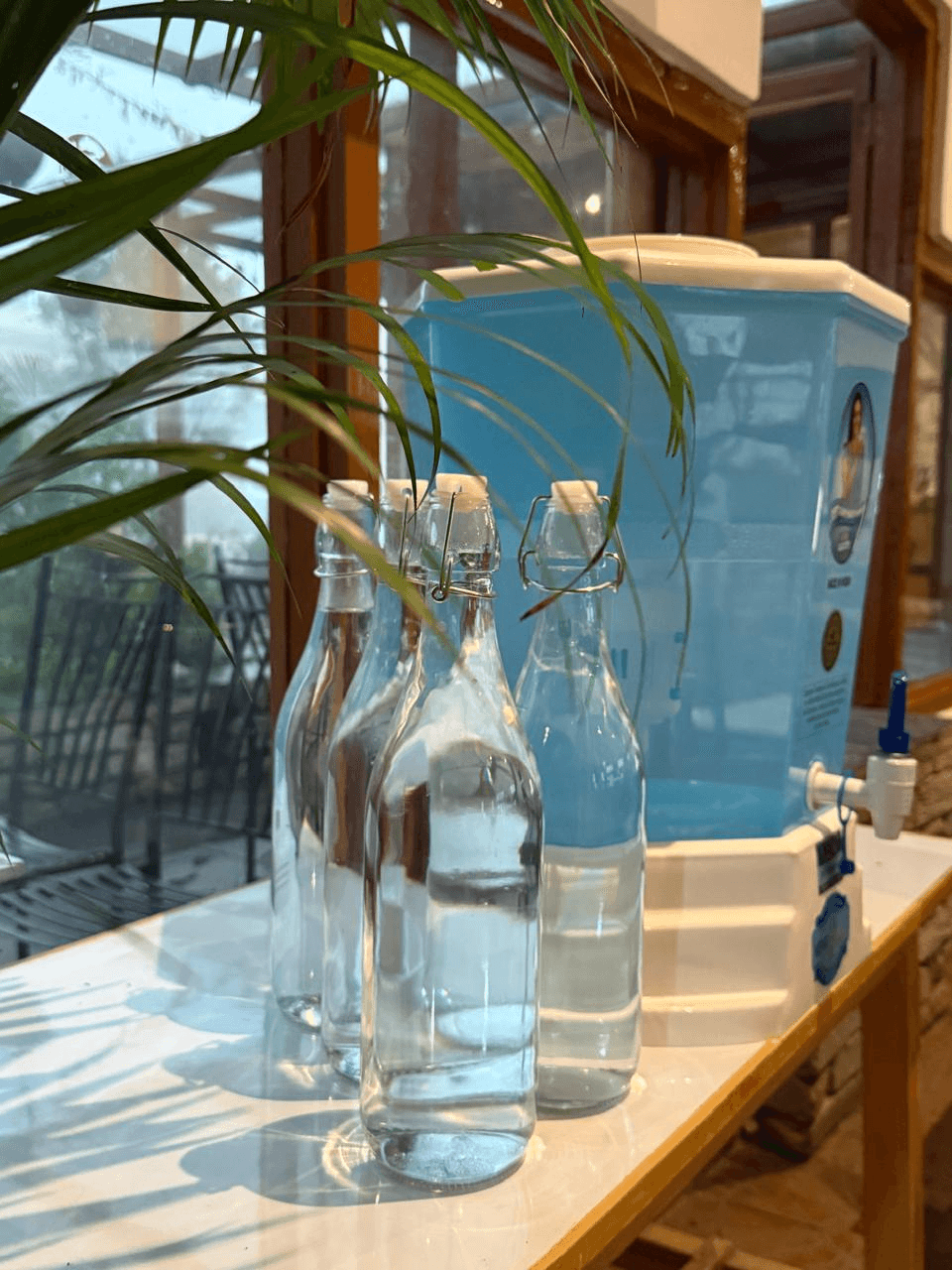
We also found a better version of gravity-based candle filters. The particular model we got is called Kent Gold Plus that is a Ultrafiltration (UF) filter that has overflow protection, filtration capacity of 20liters per hour and better bacterial filtration compared to MF filters. Replacing the filter is also easy on this system, doesn't need any special technician. We got this and it has worked wonderfully for us.
We also bought air-tight glass bottles to keep water in the guest rooms. We have a refill station with the filter in the dining room where guests can come and refill their bottle. The filter is made using food grade plastic and is placed in an area that doesn't get direct sunlight.
Of course, this system isn't without flaws. The filter needs constant refilling, glass bottles break, every three months we have to perform some maintenance, bottles need to cleaned after every guest checkout, etc. etc. But the benefit of not having plastic water bottle waste is worth all its cons.

Filter station in our dining.